
Focus this month | The Real Cost of IT Downtime

The real cost of IT downtime… and how to avoid it
A server goes offline. Within minutes, staff can’t get to their files, orders stop moving and the phone starts ringing with questions nobody can answer. What looks like an IT problem becomes everybody’s problem, fast.
Most businesses think about downtime in hours. What they don’t account for is everything underneath — the lost revenue, the compliance headaches, the customer who quietly goes elsewhere and never says why.
In sectors such as education, commerce and local government, even a short disruption can have a knock-on effect across hundreds of people. In many cases, the damage starts long before anyone notices there is a problem.

“A lot of businesses assume downtime only happens to larger organisations, until they experience it themselves.
In reality, we regularly see issues caused by simple things such as failed hardware, weak passwords or backups that have not been properly tested.”
Chris Cope, OX IT Solutions MSP Lead
Why Downtime Happens
Cyberattacks remain one of the biggest causes of unplanned downtime for organisations across the UK. Ransomware, phishing emails and compromised accounts can spread quickly through a network, locking systems and preventing access to critical data.
But not every outage comes from a malicious attack. Hardware failures, accidental deletion, software corruption and human error continue to cause major disruption.
A member of staff saves over the wrong file. A laptop fails without warning. A backup process silently stops running in the background. These issues are often less dramatic than a cyberattack, but the impact can be just as serious.
In commercial environments, it can stop orders from being processed or cut communication between teams and customers.
Local authorities face their own pressures, with downtime affecting public services, internal operations and sensitive data handling.
For schools and colleges, downtime can interrupt lessons, affect safeguarding systems and prevent access to learning platforms.

“We are a prime target for malicious attacks and the most common way is through phishing or social engineering; people will try and get through.
If we didn’t have Acronis, I don’t think we would have a platform that we would trust.”
Josh Capon, IT Operations Manager at ASSET Education Trust (pictured right)
The common thread is simple. When systems stop, work stops with them.
The hidden impact on organisations
A two-hour outage doesn’t just cost you two hours. Teams burn time working around systems that aren’t there. Customer service agents go quiet. Someone senior ends up fielding calls they shouldn’t have to field. By the time systems come back online, you’re already behind.
When systems go down, customers notice before you do. They don’t know what’s wrong, they just know something is. Orders don’t go through. Emails bounce. A call goes unanswered. By the time your team has a handle on it, confidence has already taken a knock.
There’s a compliance angle too. Data loss or a prolonged outage can create real exposure under GDPR, not just a technical risk but a governance one. Clients, parents, partners and insurers expect organisations to protect their systems and data properly. If recovery is slow, or communication is unclear, trust starts to erode quickly.
Prevention starts with preparation
No organisation can remove risk entirely, but many of the most serious incidents can be prevented, or significantly reduced, with the right foundations in place.
That starts with reliable backup and recovery. Backups should run automatically, be tested regularly, and exist in multiple locations, including secure cloud environments. This is highlighted in the best practice of having a ‘3-2-1’; having multiple locations for backup - in the cloud, onsite and offsite -which is a standard requirement of any insurance cover. Recovery should be quick, structured and predictable, not something improvised under pressure.
Cybersecurity also plays a major role. Strong password policies, multi factor authentication, endpoint protection and staff awareness training all help reduce exposure to common threats.
Monitoring matters too. Many organisations only discover problems once systems fail. Proactive monitoring helps identify unusual activity, failing hardware or backup issues before they become major incidents.
Businesses need a clear plan. When downtime occurs, people need to know what happens next, who is responsible, and how recovery will be managed.
Josh Capon said:
“As well as being compliant with DfE standards, we have peace of mind that if someone accidentally deletes a sensitive or important document, we know we can restore it exactly as it was left off. It gives me time to think; I’m not worrying about anything. I just know it is working and I can trust it. A teacher can approach me and I can have their files back within a few minutes.”
Building resilience for the long term
Reliable IT is no longer just a support function sitting quietly in the background. It underpins communication, operations, customer service and business continuity across almost every sector.
The organisations that recover fastest from disruption are usually the ones that prepared long before anything went wrong. That means moving away from reactive support and investing in a long-term technology partnership with people who understand your environment and can stay ahead of what’s coming. It could be worth considering a Managed Service that frees you up to focus on what you are best at; running the strategy and delivery of IT
OX IT Solutions works with organisations across education, commerce and local government, using trusted technologies from our roster of vendors, including WatchGuard Technologies, ESET, Acronis, to strengthen security, improve resilience and keep critical systems protected.
If you want to find out more about your data protection options, book an initial chat with OX IT Solutions today.
Found this useful?
Then check out our Data Protection webinar where two of our customers talk about the benefits of using OX IT’s Managed DR service, powered by Acronis, below.
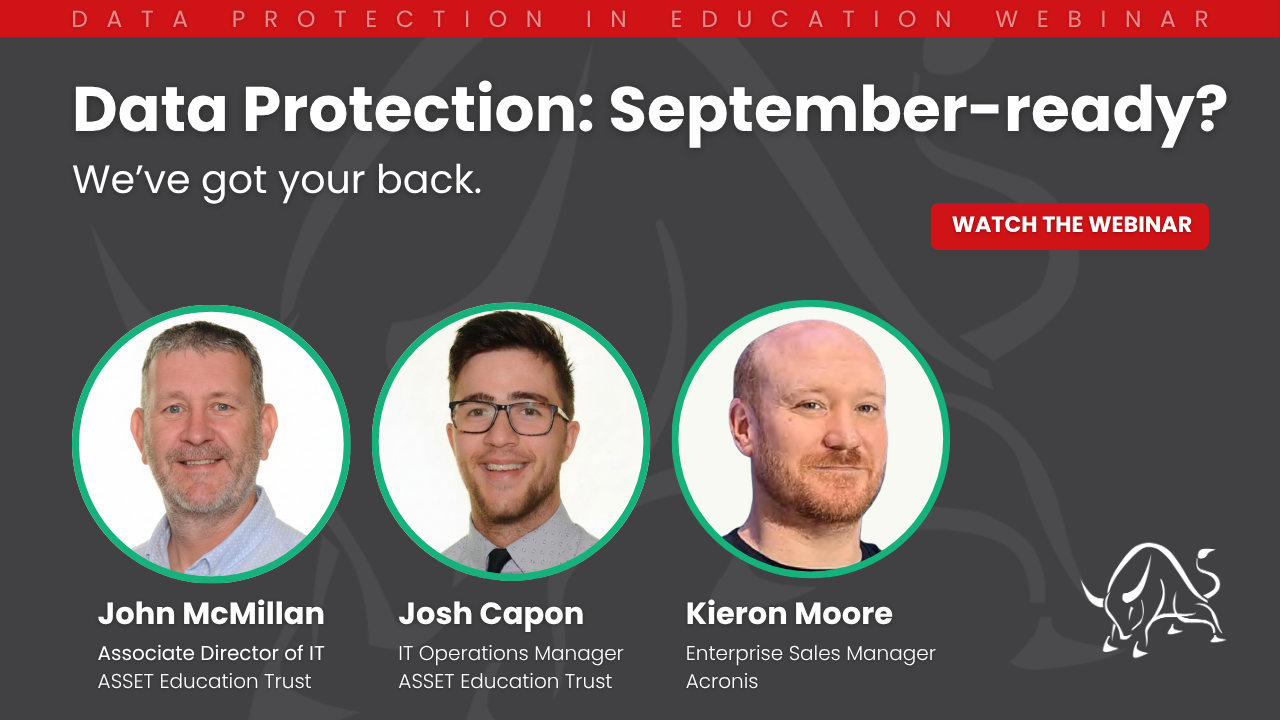
Data Protection: September-ready? Webinar
Watch our customers John McMillan and Josh Capon from ASSET Education talk about the benefits of using OX IT's Managed Service for Data Protection, which is powered by Acronis Cyber Protect. You'll also get a useful overview of the Cyber Protect solution and how it enables regulatory compliance, from Acronis expert Kieron Moore.